+86-411-85518978
zwa@zwa.cc


When a machine has to handle high axial loads, choosing the right thrust bearing can directly affect reliability, operating life, and maintenance requirements. The decision becomes more complicated when both a Thrust Spherical Roller Bearing and a Tapered Roller Thrust Bearing appear capable of handling the same basic load.
The key difference is not simply how much load each bearing can support. Their internal geometries respond differently to shaft deflection, housing deformation, misalignment, combined loading, rotational speed, and lubrication conditions. A bearing that performs well in a rigid, accurately aligned assembly may not be the right choice for equipment where the shaft or housing moves under operating loads.
For engineers and industrial equipment manufacturers, understanding these differences makes bearing selection more than a catalog comparison. This guide compares Thrust Spherical Roller Bearings and Tapered Roller Thrust Bearings across load capacity, misalignment, speed, stiffness, lubrication, and typical applications, helping you identify which Roller Bearings design better matches the actual operating conditions of your equipment.
The load-carrying behavior of a thrust bearing is largely determined by its roller and raceway geometry. Although both designs belong to the broader category of Roller Bearings, their internal structures create different ways of transferring axial force through the bearing.
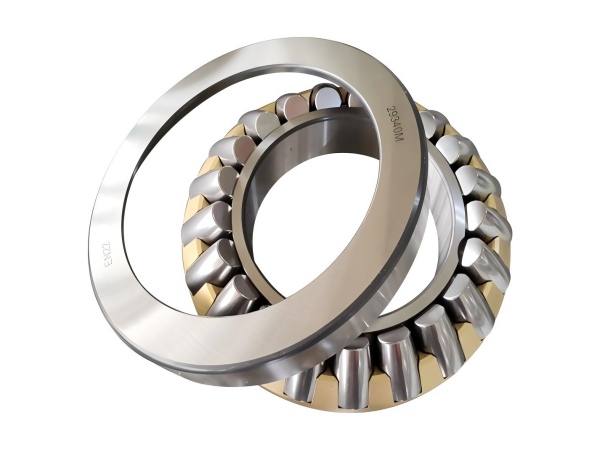
A Thrust Spherical Roller Bearing uses spherical rollers arranged between a shaft washer and housing washer. The rollers are positioned at an angle to the bearing axis, allowing the bearing to accommodate heavy axial loads while also supporting radial loads acting simultaneously.
The spherical roller geometry provides a relatively large effective contact area between the rollers and raceways. This makes the design particularly suitable for applications involving heavy loads and demanding operating conditions. The geometry also contributes to the bearing's ability to accommodate angular misalignment between the shaft and housing.
A Tapered Roller Thrust Bearing, in contrast, uses tapered rollers running between correspondingly tapered raceways. The tapered geometry directs the load through the roller-raceway contacts and is particularly suited to applications where axial load capacity and controlled load transmission are important.
The difference becomes more significant when the machine experiences combined loads. A spherical roller thrust bearing can be advantageous when considerable radial and axial forces occur at the same time. With tapered designs, the actual combination of axial and radial forces needs to be evaluated carefully to determine the appropriate bearing configuration and capacity.
| Selection Factor | Thrust Spherical Roller Bearing | Tapered Roller Thrust Bearing |
|---|---|---|
| Primary load capability | Heavy axial loads with simultaneously acting radial loads | High axial loads with controlled thrust transmission |
| Misalignment | Self-aligning design accommodates angular misalignment | Generally requires more controlled alignment |
| Radial load capability | Suitable for significant combined radial and axial loading | Depends on bearing arrangement and application conditions |
| Load distribution | Spherical roller and raceway geometry | Tapered roller and raceway geometry |
| Stiffness | High stiffness under heavy loading | High axial stiffness with controlled contact geometry |
| Typical selection priority | Combined loads and misalignment tolerance | Heavy thrust loads and controlled alignment |
Therefore, selecting between these two Roller Bearings should begin with the complete load condition rather than a single catalog rating.
Misalignment can occur for many reasons, including shaft deflection, housing deformation, manufacturing tolerances, installation errors, and thermal expansion. In large industrial machinery, the alignment measured during assembly may not be the alignment that exists once the machine is operating under load.
This is where Thrust Spherical Roller Bearings have an important design advantage. Their spherical raceway geometry allows the bearing to accommodate angular misalignment between the shaft and housing.
That does not mean a spherical roller thrust bearing can tolerate unlimited misalignment. The allowable value depends on the bearing design, operating speed, load, clearance, mounting arrangement, and other application conditions. Engineers should always use the manufacturer's specifications for the selected bearing rather than applying a general misalignment value to every model.
The self-aligning characteristic is particularly useful when shaft deflection is expected. Instead of requiring the bearing arrangement to remain perfectly aligned throughout operation, the spherical roller design can accommodate a certain degree of angular deviation while maintaining effective roller-raceway contact.
A Tapered Roller Thrust Bearing is generally more dependent on controlled alignment. Its tapered geometry is designed to produce a predictable contact relationship between the rollers and raceways. If the surrounding structure is rigid and the bearing seats are accurately machined and installed, this characteristic can be highly beneficial.
However, applications with significant structural movement require additional attention. If shaft deflection or housing deformation is expected to be substantial, engineers should determine whether the tapered bearing arrangement can maintain the required contact conditions throughout the operating cycle.
In practical terms, misalignment is therefore one of the first questions to ask when comparing these two bearing designs. If alignment cannot be maintained reliably, the self-aligning characteristics of a spherical roller thrust bearing may become an important part of the selection process.
Speed should not be used to declare one thrust bearing design universally superior to the other. The permissible operating speed of Roller Bearings depends on factors such as bearing size, internal geometry, cage design, lubrication, load, operating temperature, and cooling conditions.
For spherical roller thrust bearings, roller and cage geometry is designed to support heavy loading while controlling friction and heat generation. Proper lubrication remains essential because high axial loads can create substantial contact stress and heat during operation.
A Tapered Roller Thrust Bearing also requires carefully selected lubrication. The lubricant needs to provide an adequate film between the contacting surfaces under the actual combination of speed, load, and temperature.
Grease and oil lubrication may both be suitable depending on the application. The correct choice should consider operating speed, temperature, contamination, relubrication requirements, available cooling, and the bearing manufacturer's recommendations.
Stiffness is another important consideration. Both spherical and tapered thrust designs can provide high stiffness when properly selected and installed. However, stiffness should be considered together with alignment rather than evaluated independently.
A very rigid bearing arrangement may perform effectively in a precisely aligned machine, while a self-aligning design may be more appropriate when the shaft and housing experience movement during operation. The goal is not simply to maximize stiffness, but to maintain stable and appropriate contact conditions throughout the machine's operating cycle.
For high-speed applications, designers should also check the manufacturer's speed limits and thermal calculations instead of relying on general assumptions about bearing type. A specific bearing's limiting speed can differ substantially from another bearing of a similar size.
A Thrust Spherical Roller Bearing is often considered when an application combines heavy axial loading with radial forces, or when shaft deflection and angular misalignment are difficult to eliminate.
Heavy industrial machinery is a typical example. Large shafts can deflect under operating loads, while housings may deform slightly because of structural loads or temperature changes. In such conditions, the self-aligning characteristic of the spherical design can help maintain effective contact between the rollers and raceways.
Another consideration is combined loading. Some machines do not produce a purely axial force. Radial forces may act simultaneously because of gears, belts, structural reactions, or other mechanical components. In these situations, a spherical roller thrust bearing can provide a useful combination of axial and radial load-carrying capability.
Applications may include heavy industrial machinery, gear systems, crushers, conveyors, paper-making equipment, marine equipment, and other machines where substantial thrust loading and structural movement are present.
However, application suitability should always be verified from the actual load and operating data. Bearing selection should consider the magnitude and direction of the axial load, radial load, speed, temperature, lubrication, shaft dimensions, housing arrangement, and expected service life.
For OEMs and replacement-bearing buyers, ZWA Bearings can provide different Roller Bearings configurations for industrial applications. You can review the available bearing categories and product information through the ZWA Bearings product range.
A Tapered Roller Thrust Bearing may be appropriate when the application places a strong emphasis on axial load capacity, controlled thrust transmission, and accurate alignment.
The tapered roller geometry creates a defined relationship between the rollers and raceways. This makes the design useful in equipment where the bearing arrangement can be manufactured, installed, and maintained with controlled alignment.
Applications involving heavy axial forces and relatively rigid mechanical structures can benefit from this predictable contact geometry. The bearing arrangement can be designed around the direction and magnitude of the expected thrust load, while the surrounding shaft and housing provide the required alignment support.
However, tapered thrust bearings should not be selected simply because the catalog shows a high axial load rating. The actual application may involve radial forces, overturning moments, thermal expansion, or other factors that affect bearing loading.
Installation is also important. The shaft, housing, fits, mounting procedure, and any required adjustment or preload must be considered as part of the complete bearing arrangement. Incorrect installation can negatively affect even a correctly sized bearing.
For this reason, a Tapered Roller Thrust Bearing is generally most suitable when its controlled geometry matches the mechanical conditions of the machine and the alignment requirements can be maintained throughout operation.
When comparing Thrust Spherical Roller Bearings with a Tapered Roller Thrust Bearing, engineers should evaluate the complete operating environment rather than choosing based on one specification.
Start by identifying the actual axial load and whether radial forces act simultaneously. Then determine the expected shaft deflection and housing deformation. If the machine experiences meaningful angular movement during operation, misalignment capability should become a key selection criterion.
Next, evaluate rotational speed and operating temperature. These factors influence lubrication requirements and the amount of heat that must be dissipated from the bearing arrangement.
The installation environment should also be considered. Contamination, moisture, dust, vibration, mounting space, maintenance accessibility, and relubrication requirements can all influence the practical performance of the selected Roller Bearings.
For a new machine, bearing selection should ideally take place alongside shaft and housing design. This allows the designer to optimize fits, dimensions, lubrication, and alignment as a complete system.
For replacement applications, the original bearing designation is useful but should not always be treated as the only selection criterion. If the original bearing experienced overheating, abnormal vibration, premature fatigue, or repeated damage, the underlying operating conditions should be reviewed before specifying an identical replacement.
When the application involves unusual loads, non-standard dimensions, high operating temperatures, difficult alignment, or repeated bearing failures, supplying detailed operating information to a bearing manufacturer can make the selection process more reliable. Contact ZWA Bearings with the bearing designation, shaft size, load conditions, speed, temperature, lubrication method, and application information for further discussion.
The difference between a Thrust Spherical Roller Bearing and a Tapered Roller Thrust Bearing comes down to more than roller shape. Their different internal geometries determine how they respond to axial loads, radial loads, misalignment, shaft deflection, speed, lubrication, and structural conditions.
Thrust Spherical Roller Bearings are particularly useful for applications involving heavy loads, combined axial and radial forces, and unavoidable shaft or housing misalignment. Their self-aligning design can provide greater flexibility when the machine structure cannot maintain perfect alignment during operation.
A Tapered Roller Thrust Bearing can be a suitable solution when high axial loading, controlled contact geometry, and accurate alignment are central requirements. Its performance depends strongly on correct bearing selection, installation, lubrication, and alignment.
Ultimately, there is no universal replacement rule between the two designs. The correct choice should be based on the actual machine conditions and the complete bearing arrangement. By evaluating load, misalignment, speed, temperature, lubrication, installation, and expected service life together, engineers can select the Roller Bearings configuration that is appropriate for the application rather than simply matching a catalog dimension.
A spherical roller thrust bearing uses spherical rollers and a self-aligning raceway design, while a tapered roller thrust bearing uses tapered rollers and raceways designed for controlled axial load transmission.
Thrust Spherical Roller Bearings are designed to accommodate angular misalignment, making them particularly useful when shaft deflection or housing deformation is expected.
Yes. A spherical roller thrust bearing can accommodate substantial radial loads acting simultaneously with axial loads, subject to the specific bearing design and application conditions.
A Tapered Roller Thrust Bearing can be considered when high axial loading and controlled thrust transmission are required and the shaft and housing can maintain appropriate alignment.
Yes. Proper lubrication is essential for controlling friction, wear, and operating temperature. The appropriate lubrication method depends on load, speed, temperature, contamination, and bearing design.
Provide the existing bearing designation if available, shaft and housing dimensions, axial and radial loads, rotational speed, operating temperature, lubrication method, installation arrangement, and application environment.