+86-411-85518978
zwa@zwa.cc


A bearing can have sufficient radial load capacity and still be the wrong choice for a machine. The problem often appears when the shaft moves after the equipment reaches operating temperature. Thermal expansion, shaft deflection, and housing deformation can introduce axial movement that the original bearing arrangement was not designed to accommodate.
This is one of the situations where engineers may need to compare a Toroidal Roller Bearing with conventional Spherical Roller Bearings. Both bearing designs are intended for heavy-duty applications and can accommodate angular misalignment, but they address axial movement differently.
With a conventional spherical roller bearing arrangement, axial displacement is normally managed through the locating and non-locating bearing positions. A toroidal or CARB bearing allows axial displacement to occur within the bearing while continuing to support radial loads and accommodate angular misalignment within its specified limits.
That difference can affect bearing arrangement, mounting requirements, thermal behavior, and long-term operating reliability. For equipment such as paper machines, steel-processing systems, gearboxes, conveyors, and other heavy machinery, understanding this distinction can make the difference between simply matching a bearing size and selecting a bearing that genuinely fits the machine's operating conditions.
A Toroidal Roller Bearing is designed for applications where heavy radial loading, angular misalignment, and axial displacement need to be accommodated in the same bearing position.
CARB is the name used by SKF for its toroidal roller bearing design. Its internal geometry uses long, slightly curved rollers running on a toroidal raceway. This geometry allows the rollers to accommodate axial displacement while maintaining radial load-carrying capability.
The practical advantage becomes clearer in machines with long shafts. When operating temperature changes, the shaft can expand or contract along its axis. If the bearing arrangement prevents that movement, additional axial forces can develop within the system.
Traditional bearing arrangements can address this issue by using a locating bearing together with a non-locating bearing. The non-locating position permits axial movement through the bearing arrangement. A Toroidal Roller Bearing offers another approach by allowing axial displacement to take place internally.
This can be useful when the machine also experiences angular misalignment. Shaft deflection and housing deformation may occur at the same time as thermal expansion, meaning the bearing needs to accommodate more than one type of movement.
The toroidal design addresses this combination by allowing axial displacement without sacrificing its ability to accommodate angular misalignment within its specified operating limits.
It is important to distinguish axial displacement from angular misalignment. Axial displacement is movement along the shaft axis, while angular misalignment occurs when the shaft and housing axes are no longer perfectly aligned. A CARB-type Toroidal Roller Bearing is designed to accommodate both conditions within the limits specified for the individual bearing.
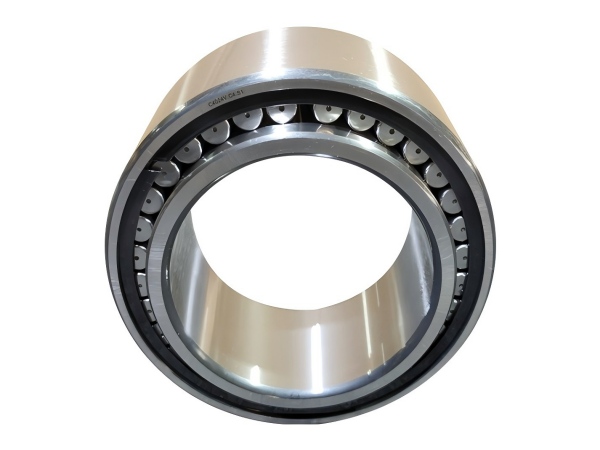
Spherical Roller Bearings are widely used in heavy industrial machinery because their internal geometry allows them to accommodate angular misalignment between the shaft and housing.
The outer ring has a spherical raceway, allowing the inner ring and roller assembly to adjust relative to the outer ring. This self-aligning characteristic is particularly useful when shaft deflection, housing deformation, manufacturing tolerances, or installation conditions create angular misalignment during operation.
For heavy radial loads, Spherical Roller Bearings provide a well-established solution across industries. Depending on the specific design, they can also accommodate axial loads in both directions.
However, self-alignment and axial displacement are two different requirements. A spherical roller bearing can accommodate angular misalignment, but a conventional spherical roller bearing arrangement does not automatically provide the same internal axial displacement capability as a CARB bearing.
In many applications, one spherical roller bearing is used as the locating bearing while another bearing position is allowed to accommodate axial movement. This arrangement can work effectively when the machine design provides sufficient freedom for the non-locating bearing position.
The situation changes when the designer wants the bearing itself to accommodate axial displacement. This is one of the main reasons to consider a Toroidal Roller Bearing instead of relying solely on a conventional spherical roller bearing arrangement.
Therefore, the question is not whether spherical roller bearings can handle misalignment. They can. The more important question is whether the complete bearing arrangement needs to accommodate axial displacement internally while maintaining self-aligning behavior.
Axial displacement is often the factor that separates these two bearing solutions.
Consider a long machine shaft operating at an elevated temperature. As the temperature changes, the shaft length can change. The amount of movement depends on the shaft material, its effective length, and the temperature change. In a properly designed bearing arrangement, this movement must have somewhere to go.
If axial expansion is restricted, the resulting forces can affect bearing loading and the surrounding components. The consequences may include increased friction, heat generation, abnormal loading, or reduced service life.
With conventional Spherical Roller Bearings, engineers commonly manage this through the locating and non-locating bearing arrangement. The locating bearing controls the shaft's axial position, while the non-locating bearing permits the required axial movement.
A Toroidal Roller Bearing approaches the problem differently. Its internal geometry allows the bearing to accommodate axial displacement while continuing to carry radial loads.
| Selection Factor | Toroidal Roller Bearing / CARB | Spherical Roller Bearings |
|---|---|---|
| Primary capability | Heavy radial loads with internal axial displacement | Heavy radial loads with self-aligning capability |
| Angular misalignment | Accommodated by toroidal roller geometry | Accommodated by spherical outer-ring raceway |
| Axial displacement | Can occur internally within the bearing | Normally managed through the bearing arrangement |
| Thermal expansion | Useful where internal axial movement is required | Requires an appropriate locating/non-locating arrangement |
| Radial loading | Suitable for heavy radial loads | Suitable for heavy radial loads |
| Shaft deflection | Can accommodate angular misalignment and axial movement | Can accommodate angular misalignment |
| Typical selection consideration | Long shafts and combined axial movement and misalignment | Heavy radial loading with angular misalignment |
This distinction is particularly relevant when designing a bearing arrangement rather than selecting an individual bearing in isolation. The shaft, housing, fits, thermal conditions, and expected movement all need to be considered together.
Load capacity remains an essential consideration for both bearing types, but it should not be evaluated independently from movement and operating conditions.
A Toroidal Roller Bearing is primarily designed for radial loading while providing the ability to accommodate axial displacement and angular misalignment. This makes the design particularly useful where a machine needs radial support without rigidly restricting axial shaft movement.
Spherical Roller Bearings are also designed for heavy radial loads and are widely used in machinery exposed to shock loads, vibration, shaft deflection, and housing deformation. Their self-aligning capability is one of their defining characteristics.
When comparing load ratings, engineers should use the manufacturer's data for the exact bearing model. Bore diameter and outside diameter alone cannot determine whether a bearing is appropriate for a specific load condition.
Speed is similarly application-specific. Neither a Toroidal Roller Bearing nor a spherical roller bearing should be assigned a universal maximum speed simply because of its bearing type. Permissible speed can depend on bearing size, cage design, internal geometry, lubrication, load, operating temperature, and cooling conditions.
Lubrication also influences operating performance. Heavy radial loads create significant contact stress, while higher speeds can increase frictional heat. The lubricant type and quantity therefore need to be selected according to the actual operating environment.
Mounting space is another practical consideration. A CARB bearing can be attractive when designers want radial load support, self-alignment, and internal axial displacement in the same bearing position. However, the actual bearing dimensions and mounting requirements must always be checked against the available space.
For Spherical Roller Bearings, the designer also needs to consider how the locating and non-locating positions are arranged. The required axial movement must be available at the appropriate bearing position, and the shaft and housing fits must be suitable for the intended function.
In other words, the smallest or highest-rated bearing is not automatically the best choice. The internal design must match the way the machine moves during actual operation.
The difference between a Toroidal Roller Bearing and Spherical Roller Bearings becomes especially relevant in industries where shafts are long, loads are high, or operating temperatures vary significantly.
Paper machines often contain long shafts and operate continuously, making thermal effects and shaft movement important design considerations. The bearing arrangement may need to accommodate radial loading while allowing the shaft to expand as operating conditions change.
In such applications, a Toroidal Roller Bearing can be considered when internal axial displacement is required together with self-aligning capability. The design can simplify the way axial shaft movement is accommodated within the bearing arrangement.
Spherical Roller Bearings can also be used in paper machinery where heavy radial loads and angular misalignment are the primary concerns. The final choice depends on the specific shaft arrangement and how axial movement is intended to be managed.
Steel-processing equipment can expose bearings to high radial loads, vibration, temperature variation, contamination, and structural deformation. These conditions place significant demands on both bearing design and lubrication.
Where shaft expansion or contraction needs to be accommodated internally, a Toroidal Roller Bearing may be considered. Where the primary requirement is heavy radial load capacity with angular misalignment and the axial movement can be handled elsewhere in the arrangement, Spherical Roller Bearings may be suitable.
The actual operating temperature and speed should be used when evaluating the bearing's lubrication and service requirements. General bearing-type assumptions are not sufficient for final selection.
Heavy machinery such as conveyors, gearboxes, crushers, industrial drives, and other large mechanical systems can experience substantial radial forces combined with shaft deflection or housing deformation.
If the machine has a long shaft and significant thermal expansion, the ability of a Toroidal Roller Bearing to accommodate axial displacement can become an important design advantage.
If the machine primarily requires heavy radial load capacity and angular misalignment while axial movement is already managed through a conventional locating/non-locating arrangement, Spherical Roller Bearings may provide the required functionality.
These examples should be treated as application considerations rather than fixed rules. Actual bearing selection requires the machine's operating data and the manufacturer's engineering specifications.
The most useful starting point is to determine how the shaft moves under real operating conditions.
If the machine experiences angular misalignment but axial movement can be managed through the conventional locating and non-locating bearing arrangement, a Spherical Roller Bearing may be an appropriate solution.
If the machine requires the bearing itself to accommodate axial displacement while continuing to carry heavy radial loads and accommodate angular misalignment, a Toroidal Roller Bearing should be considered.
Thermal expansion should be evaluated early rather than after the bearing arrangement has already been finalized. Long shafts can experience axial movement as operating temperatures change, and this movement needs to be accounted for in the mechanical design.
Engineers should also evaluate shaft deflection, housing deformation, mounting fits, internal clearance, lubrication, sealing, operating speed, temperature, and maintenance requirements.
For replacement applications, simply matching the original bearing dimensions may not always be enough. If the original bearing experienced overheating, vibration, abnormal wear, or premature failure, the operating conditions and bearing arrangement should be reviewed before selecting a replacement.
ZWA Bearings supplies industrial Roller Bearings for demanding applications and can work with customers to evaluate bearing requirements. When reviewing a potential bearing solution, it is useful to provide the shaft dimensions, radial and axial loads, rotational speed, operating temperature, lubrication method, housing arrangement, and expected axial movement.
You can review the relevant ZWA Bearings product range or contact ZWA Bearings directly for application-specific bearing requirements.
The choice between a Toroidal Roller Bearing and Spherical Roller Bearings is largely determined by how the machine needs to manage movement.
Spherical roller bearings are well established for heavy radial loads and angular misalignment. Their self-aligning geometry makes them suitable for machinery where shaft deflection and housing deformation can occur during operation.
A CARB or Toroidal Roller Bearing adds an important capability: internal axial displacement. This can make the design particularly useful for long shafts and machines where thermal expansion or other operating conditions cause axial movement.
The key is therefore not to compare the two bearing types only by load rating or dimensions. Engineers should evaluate radial load, axial displacement, angular misalignment, shaft deflection, speed, temperature, lubrication, mounting space, and the complete bearing arrangement.
When axial displacement is a significant part of the machine's operating behavior, understanding this distinction can help prevent unnecessary axial loading and create a more appropriate bearing arrangement from the beginning.
CARB is SKF's designation for a toroidal roller bearing. It is designed to accommodate heavy radial loads, angular misalignment, and axial displacement within the bearing.
Both can accommodate angular misalignment and heavy radial loads, but a Toroidal Roller Bearing is specifically designed to accommodate axial displacement internally.
Shafts can expand or contract because of temperature changes. If this movement is restricted, additional axial forces can be introduced into the bearing arrangement.
Yes, but conventional spherical roller bearing arrangements typically manage axial displacement through the locating and non-locating bearing positions rather than through the same internal displacement principle used by a CARB bearing.
Yes. They are designed for heavy radial loads and can be particularly useful where axial displacement and angular misalignment need to be accommodated together.
Evaluate radial load, axial displacement, angular misalignment, shaft deflection, speed, temperature, lubrication, mounting conditions, and the complete bearing arrangement. For demanding applications, provide these parameters to the bearing manufacturer for detailed selection.