+86-411-85518978
zwa@zwa.cc


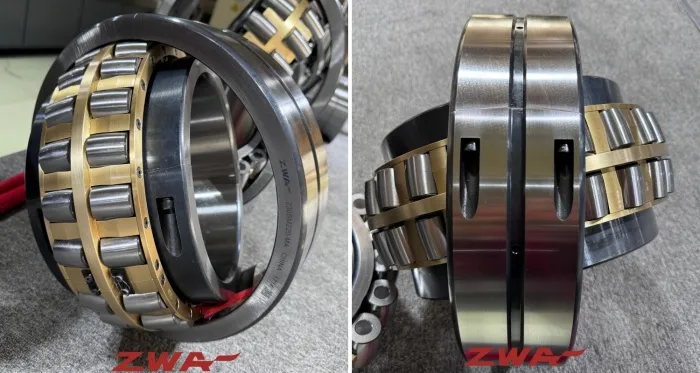
Split bearings are one of ZWA's star products. With over 20 years of experience in the field of split bearings, ZWA has been deeply involved in various heavy industry, transmission, conveying, and metallurgical equipment supporting scenarios, continuously optimizing product structure and process accuracy, and overcoming industry pain points such as cumbersome disassembly and assembly of traditional integral bearings, inability to maintain confined spaces, and high downtime costs.
High quality product performance cannot be achieved without standardized installation processes. The installation accuracy of split bearings directly determines the stability of equipment operation, the service life of bearings, and the overall failure rate of the machine. Improper installation can easily cause bearing wear, abnormal noise, heating, deviation, locking and other faults, seriously affecting the normal operation of the production line. In order to help users accurately carry out installation operations, avoid installation errors, and reduce equipment operation and maintenance costs, ZWA has compiled a standardized, implementable, and highly adaptable complete installation process for segmented bearings based on years of on-site technical service experience. The entire process is in line with industrial practical scenarios, balancing safety and accuracy.
Fine preparation before installation is a prerequisite for ensuring the stable operation of bearings. It is necessary to strictly carry out three major tasks: cleaning, inspection, and accessory verification, to eliminate impurities, defects, and incorrect installation problems.
Site and component cleaning: Thoroughly clean all supporting components such as bearing seats, shaft necks, bearing parts, seals, etc., remove surface rust, oil stains, iron filings, dust, and residual old lubricating grease, ensure that the installation contact surface is clean, dry, free of debris, and burrs. It is strictly prohibited to install with impurities to avoid wear on the bearing raceway and rolling elements caused by impurities in the later stage.
Equipment accuracy inspection: Carefully inspect the surface flatness, wear degree, and dimensional tolerances of the shaft neck to confirm that there are no defects such as rust, potholes, deformation, excessive wear, etc. on the shaft neck; At the same time, check the flatness of the inner cavity and fitting surface of the bearing seat to ensure that there are no deformation, damage, or offset issues, and that the fit clearance between the shaft and the bearing seat meets the equipment design standards.
Prepare tools: one set of Allen wrenches, one set of sockets, pointed pliers, depth gauge, tape measure, hammer, pry bar, wallpaper knife, scissors, paint pen, cloth, copper rod, micrometer, torque wrench, plug gauge.
Product and accessory verification: Verify the ZWA split bearing model, specifications, and matching parameters, confirm the alignment of the bearing half split identification, and distinguish between fixed end and free end bearings; Check that the complete set of accessories such as sealing gaskets, fastening bolts, and locating parts are complete and intact, without any missing, deformed, or loose threads. At the same time, apply a thin layer of lubricating grease evenly on the surface of the shaft neck to facilitate subsequent fitting and installation, and prevent dry friction damage to the shaft surface during installation.
Open the packaging and lift out the bearing
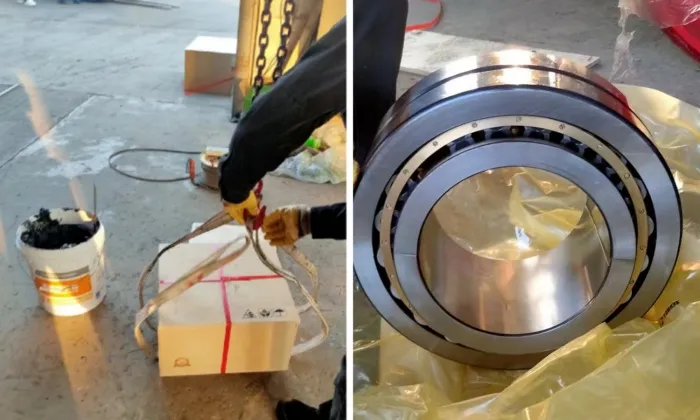
Bearing disassembly
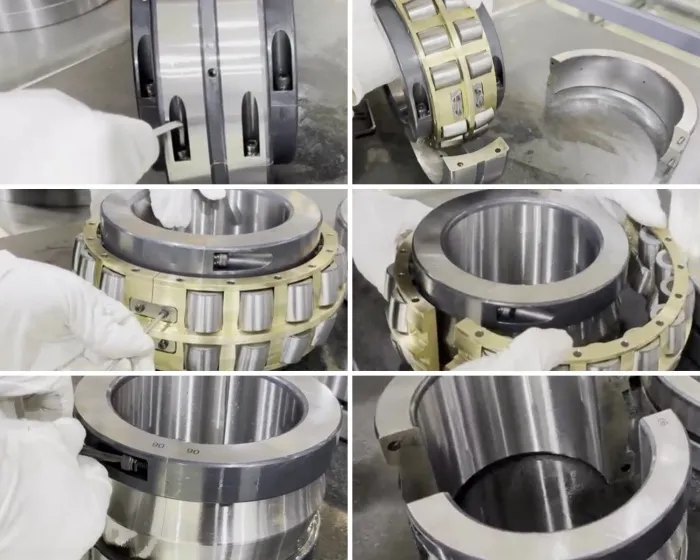
Fix the lower half bearing: Place the cleaned and calibrated lower half bearing steadily at the bottom of the bearing seat, accurately align the slot, ensure that the bottom surface of the bearing is tightly attached to the bearing seat, without suspension or offset, ensure that the contact surface is completely in contact, and avoid bearing deviation caused by uneven stress in the later stage.
Align and install the spindle: Slowly lower the spindle of the equipment to the center position of the lower half bearing shell, adjust the levelness and coaxiality of the spindle, ensure that the spindle and the bearing centerline are accurately aligned, and prevent tilting, offset, and misalignment problems. This is a key step to avoid abnormal noise and vibration during equipment operation.
Assemble the upper half bearing: Accurately fasten the upper half bearing above the main shaft, perfectly match it with the lower half bearing, align the bearing split joint, ensure that the upper and lower halves of the bearing are seamlessly fitted, the end face is flat, and the joint gap is uniform and consistent, without any misalignment or uneven gaps.
Installation of seals and end caps: Assemble the bearing seal gasket, seal sleeve, and bearing seat cover in sequence. The seals should be fully fitted to the groove without compression, wrinkles, or misalignment, to prevent oil leakage, dust ingress, and water ingress in the later stage, and to ensure the lubrication environment and dust and waterproof performance inside the bearing.
Graded tightening of bolts: The fixed bolts shall be tightened uniformly in diagonal sections, and it is strictly prohibited to lock or forcefully tighten them on one side at a time. Firstly, pre tighten the positioning with half torque, and then gradually increase the torque to the standard rated value to ensure that the bearing seat is evenly stressed and tightly fitted, avoiding bearing deformation and clearance deviation caused by uneven bolt tightening.
Gap Verification and Fine Adjustment: After installation, use a feeler gauge to accurately detect the bearing fit clearance and axial runout, and fine adjust according to the equipment standard parameters to ensure that the clearance is within a reasonable range, without excessive tightness or looseness, and is suitable for high-speed and heavy-duty operation of the equipment.
Violent installation is strictly prohibited: It is strictly forbidden to strike or press the bearing body throughout the process to avoid deformation and damage to the bearing raceway, rolling elements, and cage, which may affect accuracy and service life. If auxiliary alignment is needed, soft tools can be used to lightly tap and calibrate.
Eliminate wrong or missing installations: Strictly distinguish the bearing split identification, fixed end and free end positions, strictly prohibit misalignment of upper and lower plates, missing seals, and insufficient bolts to prevent equipment operation failures.
Strictly control the installation environment: For working conditions with high humidity, dust, and impurities, temporary protection should be taken to prevent debris from entering the bearing during the installation process. After installation, timely sealing protection should be carried out.
Prohibit over torque tightening: Bolt tightening must follow the rated torque standard. Over tightening can cause bearing deformation and clearance failure, while insufficient tightening can cause equipment vibration and bearing movement.
As a professional brand that has been deeply involved in the field of segmented bearings for more than 20 years, ZWA not only provides customers with high-quality bearing products, but also provides full process technical service support. For the installation of bearings in complex working conditions, large equipment, and special models, we can provide one-stop services such as one-on-one technical guidance, on-site installation and debugging, fault diagnosis, and customized adaptation solutions as needed to help customers completely solve installation problems, ensure long-term stable operation of equipment, and reduce operation and maintenance costs.