+86-411-85518978
zwa@zwa.cc


For large industrial shafts, the bearing replacement procedure can be almost as important as the bearing itself. When a shaft cannot be easily removed because of connected gears, couplings, drive systems, or surrounding equipment, replacing a conventional solid bearing can turn a routine maintenance task into a major shutdown.
This is where Split Bearings can provide a practical advantage. Their split construction allows the bearing to be installed or replaced around an existing shaft, reducing the need to dismantle adjacent components. However, not every split bearing is designed for the same operating conditions.
Two important designs are based on Spherical Roller Bearings and Cylindrical Roller Bearings. Spherical roller designs are commonly selected when heavy radial loads and shaft or housing misalignment must be accommodated. Cylindrical roller designs focus on efficient radial load transmission and high radial stiffness, particularly where shaft and housing alignment can be controlled.
The right choice therefore depends on more than shaft diameter. Load direction, misalignment, shaft deflection, rotational speed, lubrication, housing design, installation access, and maintenance requirements should all be considered before selecting a split bearing solution.
The primary reason for choosing Split Bearings is accessibility. A conventional solid bearing normally has to be installed from the end of the shaft or requires enough surrounding clearance to position the bearing correctly. On large industrial machines, that can mean removing couplings, gears, guards, drive components, or other assemblies before the bearing can even be reached.
A split bearing changes this maintenance approach. Because the bearing assembly is divided into sections, it can generally be fitted around the shaft without removing the shaft from the machine. This can simplify bearing replacement and inspection, particularly on equipment where shaft removal is difficult or expensive.
Typical applications may include conveyors, fans, pumps, crushers, paper-processing machinery, steel-processing equipment, mining machinery, and other large rotating systems where maintenance access is a significant consideration.
It is important, however, to distinguish a genuinely split bearing from a conventional bearing mounted inside a split housing. With a split bearing, the bearing itself is designed to support installation and maintenance around the shaft. The bearing construction, split-line design, housing arrangement, shaft fit, sealing system, and lubrication method must still be compatible with the application.
In other words, the split construction solves an installation and maintenance problem, but it does not eliminate the need for proper bearing selection.
.jpg "Split Bearings")
.jpg "Spherical Roller Bearings")
Spherical Roller Bearings use barrel-shaped rollers that operate between an inner ring and a spherical outer raceway. This geometry allows the bearing to accommodate a degree of angular misalignment between the shaft and housing.
That characteristic becomes especially valuable in industrial machines where perfect alignment is difficult to maintain during operation. Shaft deflection, housing deformation, thermal effects, installation tolerances, and structural movement can all contribute to misalignment.
When a split construction is combined with spherical roller geometry, the result is a bearing solution that addresses two separate engineering requirements: maintenance accessibility and tolerance for operating misalignment.
This makes split spherical roller designs particularly relevant where the machine experiences substantial radial loading and where shaft or housing alignment cannot be assumed to remain perfectly controlled throughout operation.
However, self-aligning capability should not be interpreted as unlimited tolerance for installation errors. The actual permissible misalignment depends on the bearing design, internal geometry, load, speed, lubrication, and manufacturer specifications.
For applications involving heavy loads, vibration, shaft deflection, or difficult maintenance access, Spherical Roller Bearings can therefore be an important option within the broader category of Split Bearings.
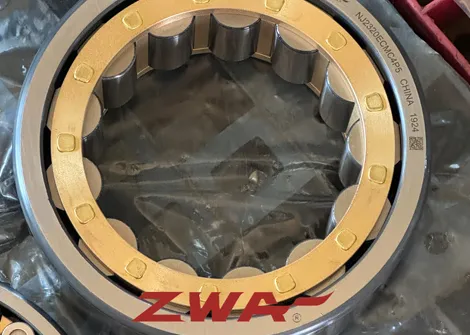
Cylindrical Roller Bearings use cylindrical rollers to transmit radial loads through line contact between the rollers and raceways. This geometry can provide high radial load capacity and strong radial stiffness.
The major distinction from spherical roller designs is their approach to alignment. Cylindrical roller bearings are generally not self-aligning in the same way as spherical roller bearings. As a result, shaft and housing alignment becomes a more important part of the overall bearing installation and operating system.
This does not make cylindrical roller designs less suitable for industrial applications. Instead, they can be advantageous when radial loading is the primary requirement and the machine structure provides good control over shaft alignment.
The specific cylindrical roller configuration also matters. Different bearing designs can have different capabilities for axial displacement and axial loading. The bearing designation and manufacturer's technical data should therefore be checked rather than assuming that all cylindrical roller bearings behave in the same way.
| Selection Factor | Split Spherical Roller Bearings | Split Cylindrical Roller Bearings |
|---|---|---|
| Roller geometry | Spherical or barrel-shaped rollers | Cylindrical rollers |
| Primary load capability | High radial load capability | High radial load capability |
| Misalignment | Designed to accommodate angular misalignment | Generally requires better shaft and housing alignment |
| Radial stiffness | High, combined with self-aligning capability | High radial stiffness and efficient radial load transmission |
| Axial behavior | Depends on the specific bearing configuration | Depends strongly on the specific configuration |
| Maintenance access | Split construction can allow installation around the shaft | Split construction can allow installation around the shaft |
| Typical selection priority | Heavy radial loads combined with misalignment | Radial loading and stiffness where alignment is controlled |
Choosing between different Split Bearings should not be based on load capacity alone. A bearing operates as part of a complete mechanical system, and load, alignment, speed, lubrication, housing rigidity, and shaft condition interact with one another.
Both spherical and cylindrical roller designs can support substantial radial loads, but the appropriate choice depends on the actual load spectrum. Continuous radial loading, shock loading, vibration, axial forces, and changes in operating conditions should all be considered.
For applications where heavy radial loads are combined with shaft deflection or housing misalignment, spherical roller designs may provide a useful combination of load capacity and alignment tolerance. Where radial load transmission and stiffness are the primary requirements and alignment is well controlled, cylindrical roller designs may be considered.
Misalignment is one of the clearest factors separating Spherical Roller Bearings from Cylindrical Roller Bearings.
Spherical roller bearings are designed with a spherical outer raceway that allows the bearing to accommodate angular misalignment. This can be particularly useful when a long shaft bends under load or when the supporting structure experiences deformation.
Cylindrical roller bearings generally require more controlled alignment. If the machine design already provides accurate shaft and housing alignment, this characteristic may not present a significant limitation. If alignment changes substantially during operation, however, the bearing selection requires closer examination.
There is no single maximum speed that applies to every spherical or cylindrical roller bearing. Permissible speed depends on factors such as bearing size, internal design, roller geometry, cage construction, load, lubrication, operating temperature, and manufacturer-specific design limits.
For this reason, bearing selection should use the technical data for the exact bearing series rather than relying on a generic speed value.
The housing is an important part of the bearing system. A suitable bearing can still experience premature problems if the housing lacks sufficient rigidity, the mounting surfaces are incorrect, the shaft dimensions are outside the required tolerance, or the sealing and lubrication arrangement is unsuitable.
With Split Bearings, the split housing and bearing construction should also be evaluated together. The installation procedure must maintain proper contact between the bearing components and housing while ensuring that the split sections are correctly positioned and secured.
Both split spherical and split cylindrical designs can reduce maintenance downtime when compared with a conventional solid bearing in applications where shaft removal is difficult.
The main advantage comes from installation access. Maintenance personnel may be able to replace the bearing around the existing shaft rather than removing the entire shaft assembly. Depending on the machine configuration, this can reduce the amount of dismantling required before bearing replacement.
The actual time savings will depend on the equipment design, maintenance procedure, bearing construction, housing arrangement, and accessibility. A split bearing does not automatically make every replacement faster, but it can remove one of the most time-consuming steps in large-shaft bearing maintenance: shaft removal.
The choice between spherical and cylindrical designs should then be based on operating conditions.
If a machine has difficult bearing access and also experiences shaft deflection or alignment changes, a split spherical roller design may address both requirements. If maintenance access is the main concern while shaft and housing alignment can be accurately controlled, a split cylindrical roller design may be appropriate where radial load and stiffness are the primary considerations.
The key point is that maintenance accessibility and operating performance should be evaluated together rather than treating them as separate decisions.
The best starting point is the actual machine rather than the bearing catalog. Before selecting Split Bearings, gather the shaft diameter and geometry, radial and axial loads, operating speed, temperature, lubrication method, expected misalignment, housing arrangement, and installation constraints.
It is also useful to understand why the existing bearing needs replacement. Excessive wear, overheating, vibration, abnormal noise, roller or raceway damage, and lubrication problems can indicate issues that should be addressed alongside the bearing replacement itself.
For buyers evaluating different bearing suppliers, the manufacturer's product range and engineering support are equally important. A supplier should be able to discuss the bearing designation, shaft requirements, housing configuration, operating conditions, lubrication, and installation procedure rather than simply matching a bearing by outside diameter and bore.
You can review the ZWA Bearings product range to explore available bearing solutions and identify the relevant product category for your application.
When the application involves a large shaft, difficult installation conditions, unusual loads, or specific operating requirements, it is also useful to contact ZWA Bearings with the basic machine and bearing information. Providing the shaft dimensions, load conditions, speed, lubrication method, housing details, and existing bearing designation can make the selection process more precise.
The choice between split spherical and split cylindrical designs depends on the operating conditions of the shaft as well as the maintenance requirements of the machine.
Split Bearings can provide a major accessibility advantage when conventional bearing replacement would require shaft removal or extensive equipment dismantling. Within this category, Spherical Roller Bearings are particularly relevant when heavy radial loads are combined with shaft or housing misalignment, while Cylindrical Roller Bearings can be considered when radial load transmission and stiffness are priorities and alignment is well controlled.
The correct selection should therefore consider load, misalignment, speed, lubrication, housing rigidity, shaft condition, and installation access together. Matching the bearing design to the actual machine conditions can help support reliable operation while making future maintenance more manageable.
Split Bearings are bearings designed with a separable construction that allows installation or replacement around an existing shaft, reducing the need to remove the shaft or dismantle surrounding equipment.
They combine the maintenance accessibility of a split design with the load-carrying and self-aligning characteristics associated with spherical roller bearing geometry.
Cylindrical Roller Bearings can be considered when high radial load capacity and radial stiffness are important and the shaft and housing alignment can be adequately controlled.
Spherical Roller Bearings are generally designed to accommodate angular misalignment, while cylindrical roller designs typically require more controlled alignment.
They can reduce maintenance work when the conventional alternative would require shaft removal or extensive dismantling. Actual time savings depend on the machine and installation arrangement.
Important information includes shaft dimensions, radial and axial loads, rotational speed, operating temperature, lubrication, expected misalignment, housing configuration, existing bearing designation, and installation constraints.