+86-411-85518978
zwa@zwa.cc


Choosing between a single row deep groove ball bearing and a double row deep groove ball bearing depends on the application’s load requirements, available installation space, and operating speed. A single-row design is usually the preferred choice for high-speed applications with moderate loads, while a double-row design is better suited for applications requiring higher radial load capacity within a limited space.
A single row deep groove ball bearing is the most widely used type of DGBB bearing, featuring one row of rolling elements between the inner and outer raceways. Its optimized raceway design allows it to support radial loads, as well as limited axial loads in both directions.
Key advantages include:
High-speed operation capability
Low friction and smooth rotation
Simple installation and maintenance
Wide availability in standard sizes
Single-row deep groove ball bearings are commonly used in electric motors, household appliances, pumps, fans, gearboxes, and general industrial equipment where speed and efficiency are important.
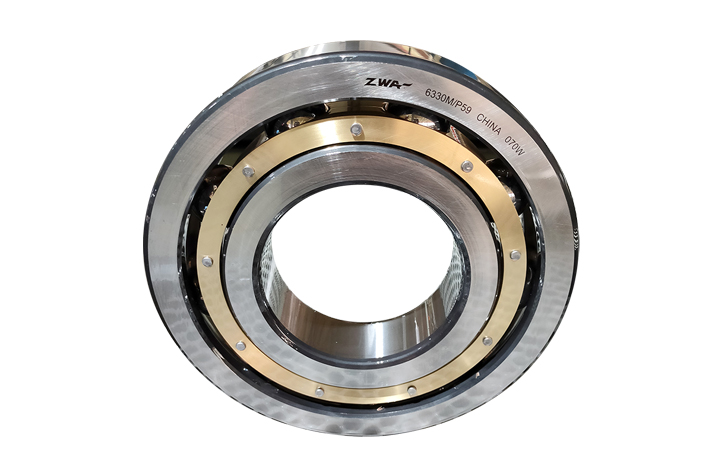
A double row deep groove ball bearing contains two rows of balls running on parallel raceways. This structure increases the number of rolling elements in contact with the raceways, providing significantly higher radial load capacity compared with a single-row design.
Typical benefits include:
Higher radial load carrying capacity
Improved rigidity under heavy loads
Better performance in compact equipment designs
Double-row deep groove ball bearings are often selected for industrial machinery, conveyors, gear drives, and applications where space limitations prevent the use of larger single-row bearings.
The primary difference between these two DGBB bearing designs is the internal structure and load capacity.
| Feature | Single-Row Deep Groove Ball Bearing | Double-Row Deep Groove Ball Bearing |
|---|---|---|
| Ball rows | One row | Two rows |
| Radial load capacity | Moderate | Higher |
| Axial load capability | Limited | Higher than single-row |
| Speed capability | Higher | Generally lower |
| Friction level | Lower | Higher |
| Installation space | Smaller | Requires wider housing space |
A single-row bearing is typically chosen when rotational speed and energy efficiency are priorities. A double-row bearing is selected when load capacity and rigidity are more critical.
A single-row design is recommended when:
The application operates at high speeds
Radial loads are moderate
Low friction and energy efficiency are required
Space and cost optimization are important
For example, electric motors and precision rotating equipment often benefit from the smooth operation and speed capability of single-row bearings.
A double-row design is more suitable when:
The equipment experiences heavier radial loads
Higher stiffness is required
Bearing space is limited but load capacity must increase
Shock or fluctuating loads are present
However, engineers should consider that double-row bearings generally generate more friction and may not be the best option for extremely high-speed applications.
Not always. Although a double row deep groove ball bearing can handle higher loads, it may have limitations in speed, lubrication requirements, and installation dimensions. Replacing a single-row bearing without checking operating conditions may reduce system performance.
Yes, but within limits. Both single-row and double-row deep groove ball bearings can support axial loads in both directions, but they are primarily designed for radial loads. Applications with high axial loads may require specialized bearing types.
No. DGBB bearing life depends on correct selection, including load rating, speed, lubrication, alignment, and operating environment. An oversized bearing may create unnecessary friction and reduce efficiency.
The main difference is the number of ball rows. A single row deep groove ball bearing has one row of balls for high-speed and efficient operation, while a double row deep groove ball bearing uses two rows to increase load capacity and stiffness.
A single-row DGBB bearing is generally better for high-speed applications because it produces less friction and operates more efficiently.
A double row deep groove ball bearing is usually the better choice when higher radial load capacity and improved rigidity are required.
Consider the operating speed, radial and axial loads, available installation space, lubrication conditions, and required service life. Selecting the correct bearing structure ensures better reliability and reduces maintenance costs.
Choosing between a single-row and double-row deep groove ball bearing requires balancing load capacity, speed performance, and application requirements. ZWA Bearings provides reliable DGBB bearing solutions for industrial equipment, helping customers select the right bearing design for improved performance and longer service life.